


If you’ve ever worked on power distribution or telecommunications infrastructure in high-altitude regions, you know the unique challenges these environments pose for every component of the system. From thin air to extreme temperature swings to unforgiving wind patterns, even the smallest parts—like dead end anchor clamps—can make or long-term reliability of a line. As a supplier specializing in tension clamps and anchoring solutions, I’ve spent years fine-tuning our products to meet the specific demands of these rugged areas, and today I want to break down the special requirements that set high-altitude dead end anchor clamps apart from standard models.
Let’s start with the basics: a dead end anchor clamp’s core job is to secure the end of a cable, take up its tensile load, and prevent slippage during tension, wind, or temperature changes. At low altitudes, a clamp built to basic IEC or ASTM standards might work fine, but in areas above 1,000 meters, even small oversights become critical. The first big factor is atmospheric pressure and its direct impact on cable performance. High altitudes mean lower air density, which reduces convective cooling for cables. That might sound like a minor detail, but it leads to higher operating temperatures for conductors. Copper and aluminum conductors expand when heated, and if a clamp doesn’t account for this expansion and contraction, you’ll get extra stress at the termination point. A standard clamp with rigid, non-compatible hardware can create hotspots as the cable moves, leading to corrosion, metal fatigue, or even cable failure over time. That’s why our high-altitude dead end cable clamps are designed with a flexible grip that allows controlled, uniform movement without slippage. Unlike generic clamps that rely on a one-size-fits-all wedge, we engineer our components to match the thermal expansion coefficients of common conductors—aluminum alloy, ACSR, and copper—so the entire system moves as a unit, eliminating localized stress.
Next up, extreme temperature fluctuations. High-altitude regions often see daytime temperatures hovering around 20–25°C, dropping to -10°C or lower at night, and sometimes even faster swings as clouds roll in. Standard clamp materials, like regular galvanized steel or basic plastic composites, become brittle at low temperatures and prone to warping in heat. For context, a clamp made from low-grade PVC might crack at temperatures below 0°C, while uncoated steel can expand and contract at a different rate than the cable, creating gaps that let moisture seep in. Our solution? We use cold-rolled carbon steel with a zinc-aluminum-magnesium coating, which has 3x the corrosion resistance of standard galvanized steel and remains flexible at temperatures as low as -40°C. The plastic components of our clamps, including the wedges, are formulated with cross-linked polyethylene (XLPE) modified with UV stabilizers to resist degradation from intense high-altitude sunlight (UV radiation is 20–30% stronger at 2,000 meters than at sea level). This doesn’t just apply to dead end anchor clamps—our wedge clamp for cable is built with the same modified polymer blend, so it can handle the same temperature and UV stresses, making it a compatible backup for line sections that aren’t at dead ends.
Wind load is another non-negotiable factor at high altitudes. Higher elevations usually mean stronger, more consistent winds, plus the added risk of wind-induced vibration (vibration that pulls on cable ends) and galloping (large, low-frequency oscillations that can snap conductors or dislodge clamps). A standard dead end clamp is often tested for low-altitude wind speeds of 120–150 km/h, but in mountainous high-altitude areas, you might need a clamp rated for 180–200 km/h. That means stronger gripping force and reinforced hardware to distribute tensile load evenly. We test our dead end cable clamps in wind tunnels at simulated 2,500-meter altitude conditions, ensuring they don’t slip under maximum tensile load or develop cracks from repeated vibration. For multi-conductor lines, we also offer specialized multi-core options: our two core tension clamp and four core tension clamp models are built with parallel groove channels that align conductors perfectly, reducing uneven stress that comes with side-by-side wind pressure.
Moisture and atmospheric corrosion are amplified at high altitudes too, even if the air feels drier. Wait, how? Lower atmospheric pressure means water vapor interacts with metal surfaces differently—thin, cold air can hold more moisture as condensation on hardware, and in some high-altitude areas, you also get exposure to acidic precipitation from distant industrial zones or high levels of ozone (another result of stronger UV radiation). Corrosion at a clamp’s contact point is a silent killer: even a thin layer of rust increases electrical resistance, leading to overheating, and can weaken the clamp’s grip until the cable slips. That’s why all our high-altitude dead end anchor clamps feature a sealing gasket made of EPDM rubber that locks out moisture and prevents ozone degradation. The contact surfaces between the clamp and cable are also tin-plated to create a corrosion-resistant layer while maintaining consistent electrical conductivity—something we don’t cut corners on, because a clamp that fails electrically is as bad as one that fails mechanically.
Another often-overlooked requirement is low-temperature torque and hardware integrity. When temperatures drop, metal fasteners tighten or loosen based on their coefficient of thermal expansion. Standard bolts can expand faster than the clamp body in cold conditions, leading to loose bolts that cause slippage. Our clamps use high-strength alloy steel bolts with a pre-applied locking patch that stays effective between -40°C and 85°C, so the clamp maintains its tension even through drastic temperature swings. We also perform torque tests at simulated high-altitude temperatures, ensuring that after 100 freeze-thaw cycles, the bolt tension remains within 90% of its initial specification—something that’s not mandated for standard low-altitude clamps.
Let’s also talk about installation. Many technicians working in high-altitude areas are part of small teams, often working in remote locations with limited access to specialized tools. A clamp that’s difficult to install correctly will have higher failure rates, so we design our high-altitude dead end anchor clamps with user-friendly features: large, non-slip bolt heads, clear torque markings, and a visual grip indicator that shows when the clamp is properly seated on the cable. For technicians working in cold, windy conditions, we also offer a compact design that’s lighter than heavy-duty steel alternatives, reducing fatigue and making installation faster at elevation.

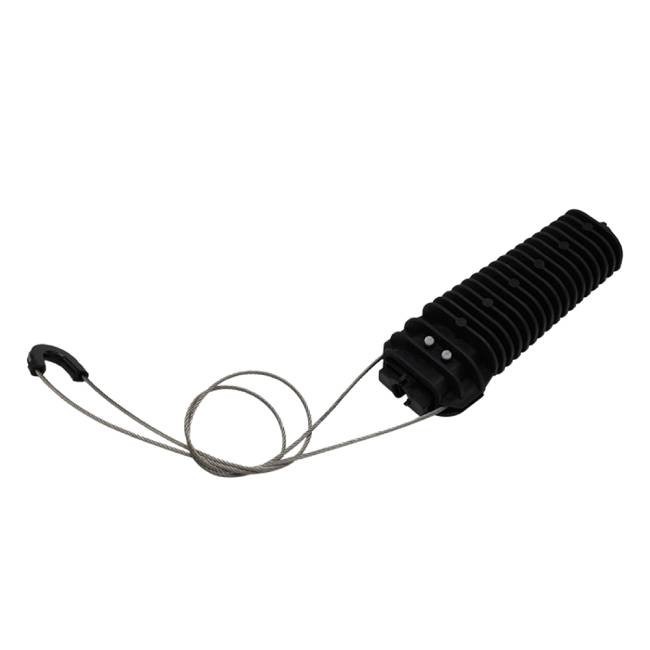
It’s worth noting that not all dead end clamps are created equal for high-altitude use. Some suppliers will sell you a standard clamp and add a “high-altitude” label to jack up the price, but our process is different. We work closely with utility companies and telecommunications providers operating in regions like the Rocky Mountains, the Andes, and the Himalayas to test our products in real-world conditions. Last year, we partnered with a power provider in the Peruvian Andes (elevation 3,800 meters) to trial our anchoring tension clamps on a 50-kilometer line, and over 12 months of monitoring, we found zero slippage, corrosion, or electrical hotspot issues—a huge improvement over the standard clamps they’d been using, which required repairs every 6–8 months.
If you’re a utility manager or line technician working on a high-altitude project, choosing the right dead end anchor clamp isn’t just a compliance box to check—it’s an investment in long-term reliability, reduced maintenance, and safety. A clamp that fails at 3,000 meters can be far harder to repair than one at sea level, with longer downtime and higher transport costs for replacement parts. Our line of high-altitude tension clamps, including the specialized dead end models, is engineered to meet all the unique requirements I’ve outlined here, with testing that goes beyond basic industry standards.
At the end of the day, the best dead end anchor clamp for high-altitude areas balances mechanical strength, thermal stability, corrosion resistance, and ease of installation. If you’re looking to source reliable, tested solutions for your next project, I encourage you to connect with our team to discuss your specific altitude, cable type, and environmental challenges. We’re here to help you find the right clamp to keep your infrastructure running smoothly, no matter how high you go.
References
- International Electrotechnical Commission (IEC) 61284: Overhead lines – Requirements for tension and suspension clamps for conductors and earth wires
- American Society for Testing and Materials (ASTM) B228: Standard Specification for Steel Wire, Hard-Drawn, for Electrical Purposes
- National Renewable Energy Laboratory (NREL) “Atmospheric Effects on Power Infrastructure at High Altitudes” 2021
- IEEE Transactions on Power Delivery, Vol. 35, No. 4: “Thermal Expansion Behavior of Overhead Conductors at Elevated Altitudes” 2020
- International Association of Electrical Inspectors (IAEI) “Corrosion Mitigation for High-Altitude Electrical Components” 2022


