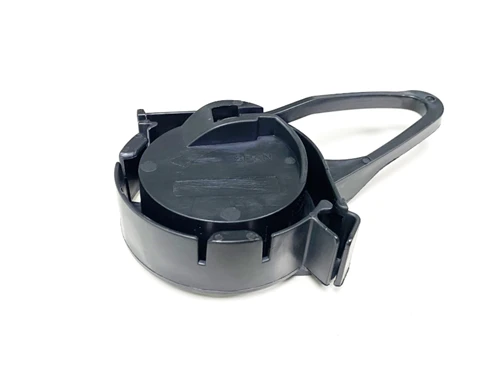

Flat vs. Round FTTH Drop Cable Clamps: How to Choose Without Damaging the Fiber
FTTH drop cable clamps are small components, but they play an important role in the reliability of aerial fiber optic networks. A correctly selected clamp transfers mechanical tension from the drop cable to a pole, wall hook, bracket, or other supporting structure while keeping excessive pressure away from the optical fiber.
For procurement teams, installers, distributors, and FTTH project engineers, one common question is whether a flat drop cable clamp can be used with a round cable, or whether one universal clamp can safely handle different cable shapes.
The answer is: not always.
Flat and round FTTH drop cables have different cross-sectional geometries, jacket structures, and mechanical characteristics. The clamp must therefore match the cable shape, dimensions, installation load, and mounting method.
Choosing the wrong clamp may cause cable slipping, jacket deformation, excessive local pressure, unstable tension, or long-term optical performance problems.
This guide explains the main differences between flat and round FTTH drop cable clamps and provides a practical selection and installation method for avoiding fiber damage.
1. What Is an FTTH Drop Cable Clamp?
An FTTH drop cable clamp is a mechanical accessory used to secure and anchor fiber optic drop cables during FTTH and FTTx deployment.
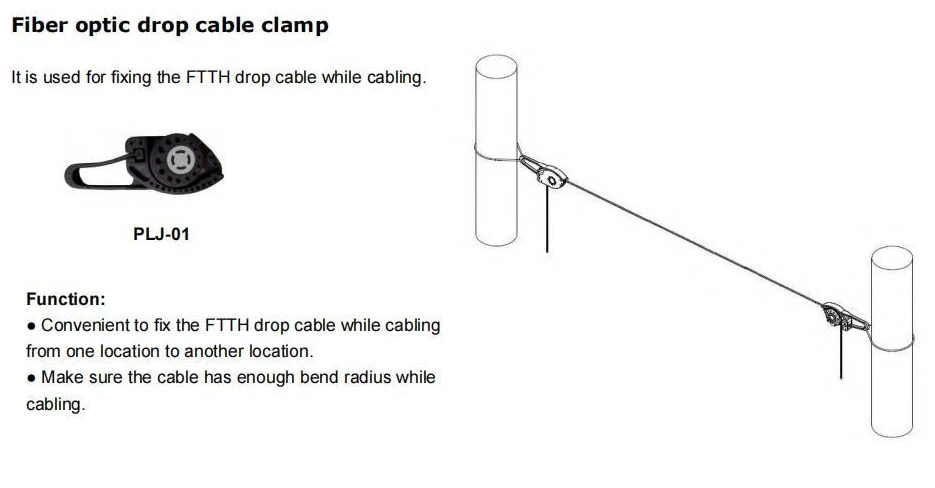
In aerial applications, the clamp normally connects the drop cable to a pole, hook, eye, bracket, facade anchor, or other supporting hardware.
Its main functions are:
Holding the drop cable securely
Transferring tensile load to the supporting structure
Preventing cable slipping under tension
Maintaining a suitable cable exit direction
Protecting the cable jacket from excessive mechanical damage
Helping maintain a controlled bending condition near the anchoring point
Supporting fast and repeatable field installation
The important principle is simple:
The clamp should hold the cable mechanically without creating unnecessary pressure on the optical fiber.
The optical fiber itself should not become the primary load-bearing element of an aerial drop installation.
Modern FTTH drop cables may use different constructions, including flat self-supporting cables, round drop cables, and other small-diameter outdoor fiber cables. Therefore, the clamp should always be selected according to the actual cable construction rather than only the product name.
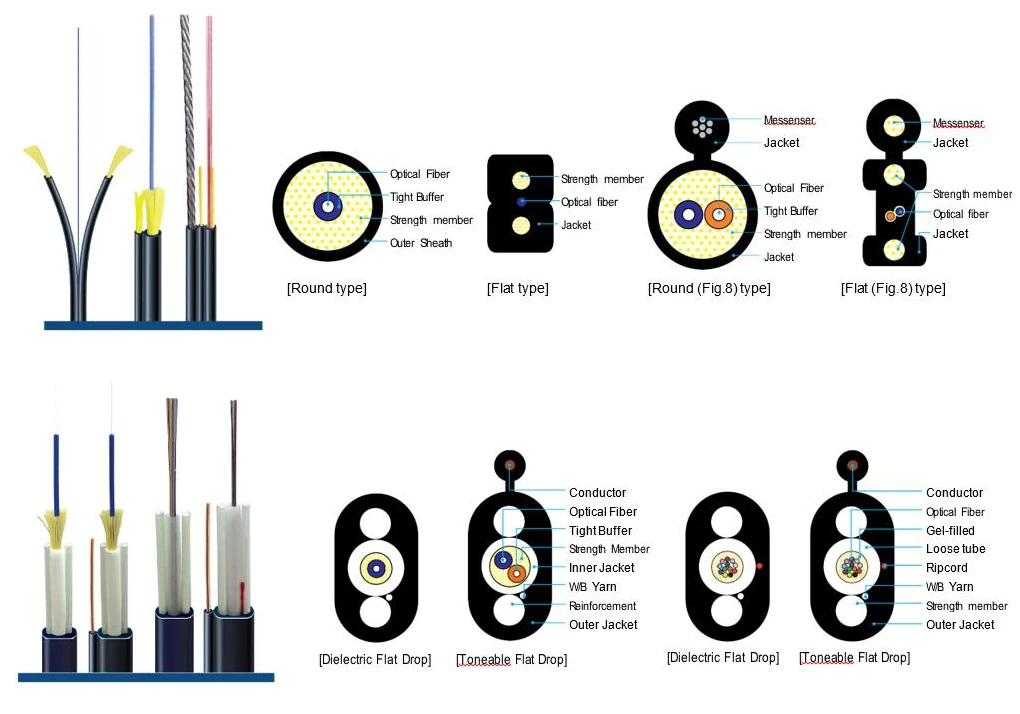
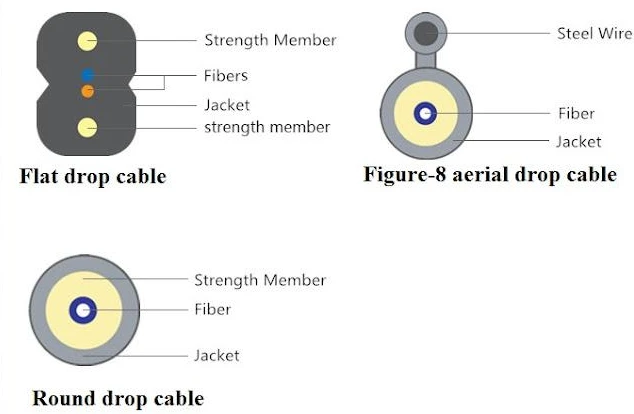
2. Flat FTTH Drop Cable vs. Round FTTH Drop Cable
Before selecting the clamp, the cable itself needs to be identified.
Flat FTTH Drop Cable
Flat drop cables are widely used in residential FTTH deployments.
A typical flat drop cable has a relatively rectangular cross-section. Depending on the cable construction, strength members may be positioned on both sides of the optical fiber.
Common advantages include:
Compact structure
Easy handling
Lightweight design
Convenient aerial installation
Suitable for many last-mile FTTH applications
Easy routing along walls and poles
Because the cable has a wider and flatter cross-section, the clamp needs to provide sufficient contact across the cable surface.
A clamp designed specifically for flat drop cable normally uses a flat or appropriately shaped gripping area rather than forcing the cable into a narrow circular groove.
Round FTTH Drop Cable
Round drop cables have a circular cross-section.
The internal construction can vary according to the cable manufacturer and application. Strength members, aramid yarn, fiber tubes, or other protective structures may be arranged differently.
Round cables can offer:
Uniform circular geometry
Convenient routing
Good mechanical flexibility
Easy compatibility with certain round cable accessories
Applications in indoor, outdoor, aerial, or building-entry environments
The key selection parameter for a round cable clamp is normally the cable outside diameter.
For example, a clamp intended for a 2.5–5 mm cable should not automatically be used for a 6–8 mm cable simply because the cable is also round.
The actual cable diameter must fall within the clamp manufacturer's specified range.

3. Why Cable Shape Matters When Selecting a Clamp
Cable geometry determines how mechanical pressure is distributed.
A correctly matched clamp spreads the gripping force over an appropriate contact area.
An incorrectly matched clamp may concentrate force on a small part of the cable jacket.
This is particularly important for FTTH installations because the optical fiber is located inside the cable structure.
Consider two basic situations.
Flat cable installed in a round groove
A flat cable placed into a circular groove may only contact the groove at limited points.
When the cable is tensioned, the force can become concentrated along the edges or corners of the cable.
Possible problems include:
Jacket deformation
Cable movement
Reduced mechanical stability
Localized pressure
Long-term jacket wear
Round cable installed in an unsuitable flat groove
A round cable may be forced into a groove designed for a flat cable.
The cable can become flattened or unstable inside the clamp.
This may increase local compression and reduce the effectiveness of the gripping structure.
Therefore, the correct question is not simply:
"Can this clamp physically hold the cable?"
The better question is:
"Does this clamp hold the cable with the correct contact geometry and within its specified mechanical range?"
4. Flat vs. Round FTTH Drop Cable Clamp Comparison
| Selection Factor | Flat Drop Cable Clamp | Round Drop Cable Clamp |
|---|---|---|
| Cable shape | Flat / rectangular | Circular |
| Main sizing method | Cable height × width | Cable outside diameter |
| Contact geometry | Flat or matched profile | Circular or contoured groove |
| Typical application | Residential FTTH aerial drop | FTTH/FTTx round drop cable |
| Main installation concern | Prevent edge pressure and slipping | Prevent excessive radial compression |
| Cable measurement | Measure height and width | Measure actual outside diameter |
| Typical material | UV-resistant plastic, PA66, stainless steel | PA66, UV-resistant plastic, stainless steel |
| Installation | Wedge, hook, bail or locking structure | Wedge, groove, bail or locking structure |
| Key selection factor | Cable dimensions + load | Cable diameter + load |
| Main risk of wrong selection | Localized pressure or unstable grip | Flattening, slipping or excessive compression |
The important point is that the cable shape is only the first selection factor.
A complete selection should also consider cable dimensions, span length, tensile load, mounting hardware, environmental conditions, and installation method.
5. How Can the Wrong Clamp Damage the Fiber?
A clamp normally contacts the outer jacket rather than the optical fiber directly.
However, excessive or uneven mechanical pressure can still affect the cable structure.
There are several mechanisms that installers should consider.
5.1 Excessive compression
If the clamp is too small, the cable may be compressed more than intended.
The outer jacket can deform, and the internal components may also experience additional mechanical stress.
5.2 Point loading
A sharp edge or poorly matched groove can concentrate force at a small contact point.
Instead of distributing the load across the cable, the clamp creates a high-pressure area.
5.3 Cable slipping
If the clamp is too large, the opposite problem occurs.
The cable may not be held securely.
Under wind vibration or long-term tensile loading, the cable can gradually move through the clamp.
This can increase the effective tension on the cable and change the cable's position at the termination point.
5.4 Excessive bending near the clamp
Even when the clamp size is correct, improper installation can create a sharp transition immediately outside the clamp.
The cable should leave the clamp smoothly rather than being forced into a tight bend.
This is particularly important when working around building corners, pole hardware, and customer drop points.
6. The Most Important Selection Data: Cable Size
Do not select a drop clamp only by cable type.
Always confirm the actual cable dimensions.
For flat cable, record:
Cable height × cable width
For example:
2.0 × 5.0 mm
For round cable, record:
Cable outside diameter
For example:
5 mm, 6 mm, or another specified diameter.
The manufacturer's product range must then be checked.
A clamp advertised as "FTTH drop cable clamp" does not automatically mean it is compatible with every FTTH drop cable.
This is one of the most common procurement mistakes.
Before ordering, send the supplier:
Cable type
Cable dimensions
Cable construction
Required span
Required installation load
Mounting hardware type
Outdoor or indoor application
Expected environmental conditions
This information allows the supplier to recommend a suitable clamp rather than simply selecting a visually similar product.
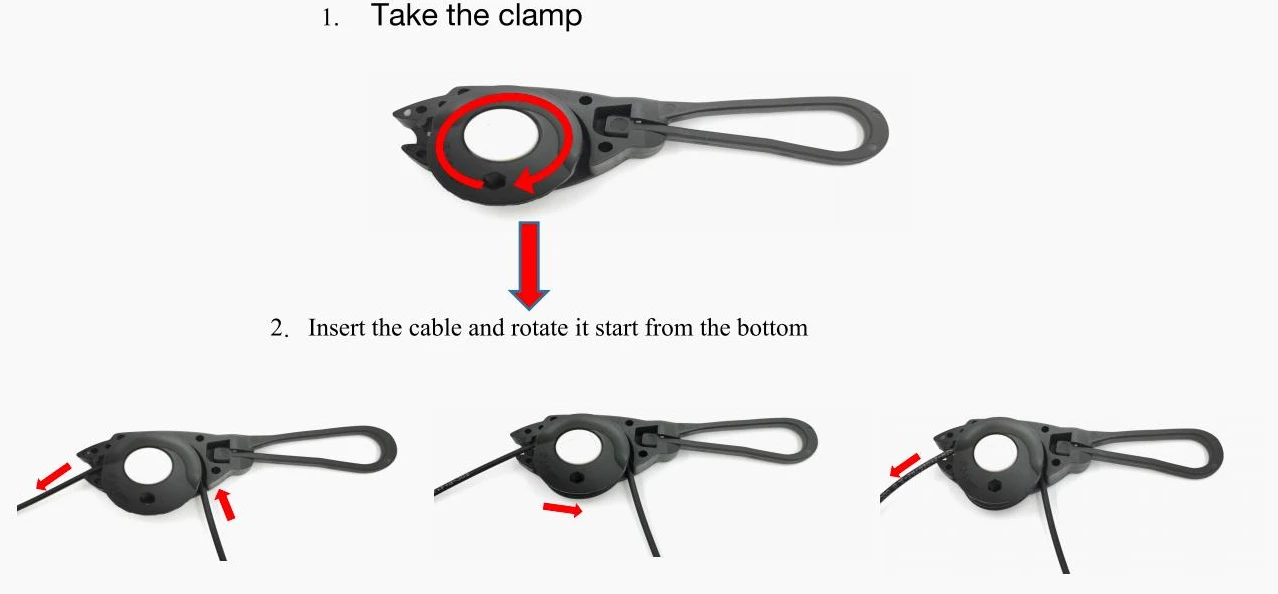
7. Installation Method: How to Avoid Excessive Pressure
Although different clamp designs have different installation procedures, the basic principles are similar.
Step 1: Confirm the cable size
Measure the actual cable before installation.
Do not rely only on memory or a general cable category.
If the cable is flat, measure both height and width.
If it is round, measure the outside diameter.
Step 2: Inspect the clamp
Check the clamp body, wedge, shim, bail, groove, and locking mechanism.
Look for:
Sharp edges
Damaged plastic
Deformed metal parts
Foreign material
Incorrect groove size
The gripping surface should be clean and free from damage.
Step 3: Position the cable correctly
Place the cable into the designated cable path.
For a flat cable, make sure the cable is not twisted.
The wide and narrow dimensions should remain aligned with the clamp's designed contact surface.
For a round cable, make sure it is centered inside the groove rather than sitting on one edge.
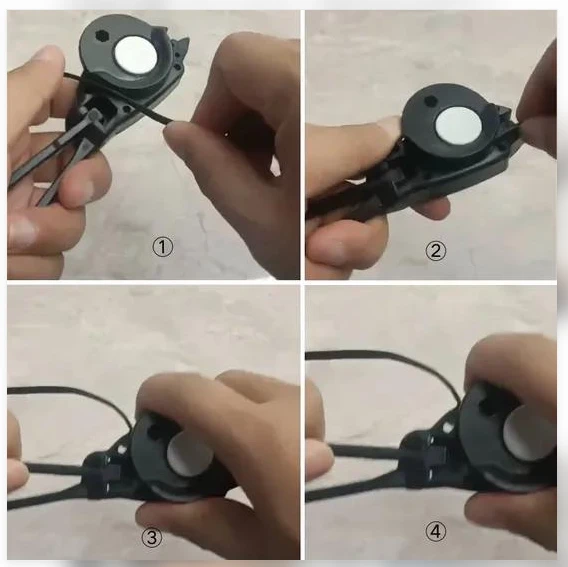
Step 4: Engage the wedge or locking structure
Many FTTH drop clamps use a wedge-type or self-locking mechanism.
As the cable experiences tensile force, the wedge can increase the gripping action.
The installer should follow the manufacturer's installation direction rather than forcing the wedge aggressively.
Step 5: Secure the bail or hook
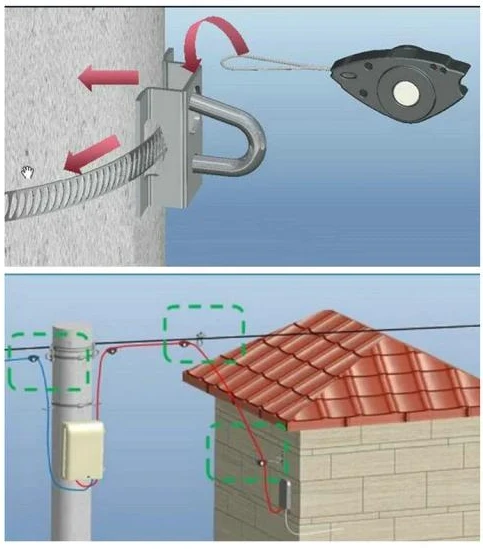
Attach the clamp to the pole, wall anchor, eye, hook, or other supporting hardware.
The supporting point must be strong enough for the expected mechanical load.
Step 6: Check the cable exit
After installation, inspect the cable immediately before and after the clamp.
The cable should leave the clamp smoothly.
Avoid sharp bends or sudden direction changes.
Step 7: Perform a visual and mechanical inspection
Check:
Cable alignment
Clamp position
Wedge position
Bail locking
Cable jacket condition
Supporting hardware
Cable sag
Clearance from nearby objects
A correct installation should provide secure mechanical support without visible jacket deformation.
8. Do Not Confuse FTTH Drop Clamps With ADSS or ABC Clamps
Another common purchasing mistake is using a clamp from another cable category simply because the size appears similar.
FTTH drop clamps are designed for relatively small drop cables.
ADSS cables generally have different diameters and significantly different mechanical requirements.
ABC bundled cable accessories are designed for insulated power conductors and have completely different electrical and mechanical considerations.
Therefore:
FTTH drop cable clamp ≠ ADSS tension clamp ≠ ABC anchor clamp.
The clamp must match the cable construction and application.
For example, an aerial FTTH residential drop may only require a compact wedge-type anchor clamp, while a larger ADSS span may require a dedicated suspension or dead-end system.
Using the wrong accessory can create both installation and long-term reliability problems.
9. When Should You Choose a Flat Cable Clamp?
Choose a flat drop cable clamp when the cable manufacturer specifies a flat or rectangular FTTH drop cable and the clamp's dimensional range matches the cable.
Typical applications include:
Residential FTTH last-mile connections
Aerial subscriber drops
Pole-to-building connections
Building facade installation
Short aerial spans
FTTB and FTTx access networks
The clamp should provide stable contact without crushing the flat cable.
For large-scale projects, it is useful to standardize the clamp according to the most common cable dimensions used by the network operator.
This can simplify procurement and reduce installation errors.
10. When Should You Choose a Round Cable Clamp?
Choose a round cable clamp when the actual drop cable has a circular cross-section and falls within the manufacturer's specified diameter range.
Typical applications include:
Round FTTH drop cables
Small outdoor fiber cables
Building-entry fiber cables
Certain FTTx aerial routes
Retrofit installations
The most important parameter is the actual outside diameter.
Do not estimate the diameter visually.
Different cable constructions can have similar appearances while having different outside diameters.
11. Can One Clamp Support Both Flat and Round Cables?
Some FTTH drop clamps are specifically designed for both flat and round cables.
However, this does not mean every universal clamp is suitable for every cable.
A dual-purpose clamp should clearly specify:
Compatible flat cable dimensions
Compatible round cable diameter
Maximum breaking load
Material
Installation method
Mounting interface
Environmental conditions
For example, a manufacturer's specification may define one size for flat cables and another range for round cables.
This is a useful approach for distributors because one clamp family may cover multiple common cable constructions.
However, the actual cable must still be checked against the published range.
12. Installation Environment Also Matters
Cable shape is only one part of the selection process.
The installation environment should also be considered.
Pole installation
Pole-mounted FTTH clamps should be compatible with the available hooks, brackets, rings, or other hardware.
The clamp should remain securely attached during wind and vibration.
Wall installation
For building facades, the anchor point must be structurally suitable.
The clamp itself cannot compensate for a weak wall anchor.
Coastal environments
Salt and humidity can accelerate corrosion of metallic components.
Stainless steel or appropriately protected hardware may be preferred depending on the project specification.
High UV environments
Plastic components should be made from UV-resistant materials suitable for outdoor use.
PA66 and other UV-stabilized engineering plastics are commonly used in outdoor fiber accessories.
Cold environments
The clamp material should maintain suitable mechanical performance at the project's minimum operating temperature.
The supplier should provide applicable temperature and environmental test information when required.
13. Common Mistakes When Buying FTTH Drop Cable Clamps
Mistake 1: Choosing by appearance
Two clamps may look almost identical but have different cable ranges.
Always check technical specifications.
Mistake 2: Checking only cable width
For flat cables, both height and width matter.
A clamp designed for a 2 × 5 mm cable should not automatically be assumed suitable for a 3 × 5 mm cable.
Mistake 3: Ignoring tensile load
The clamp must be capable of handling the expected mechanical load.
Span length, wind, ice, installation configuration, and cable weight can affect the required mechanical performance.
Mistake 4: Using excessive installation force
More force does not always mean better gripping.
The clamp should work according to its designed mechanism.
Excessive force may deform the cable or damage the clamp.
Mistake 5: Creating a sharp cable bend
The cable should leave the clamp smoothly.
Avoid pulling the cable sharply around the clamp body.
Mistake 6: Using the wrong mounting hardware
A technically correct clamp can still fail if it is attached to an unsuitable hook, eye, bracket, or wall anchor.
The complete mechanical system needs to be considered.
14. A Practical Procurement Checklist
Before placing an FTTH drop cable clamp order, buyers can use the following checklist:
Cable information
Flat or round?
Actual cable dimensions?
Cable construction?
Fiber count?
Self-supporting or messenger-supported?
Mechanical requirements
Required span?
Required tensile load?
Dead-end or suspension application?
Expected wind or environmental conditions?
Clamp requirements
Compatible cable range?
Material?
UV resistance?
Corrosion resistance?
Installation method?
Mounting interface?
Maximum breaking load?
Quality requirements
Material inspection
Dimensional inspection
Tensile testing
Environmental testing where applicable
Sample installation
Pre-shipment inspection
For large FTTH projects, testing the clamp with the actual cable before mass production is strongly recommended.
A sample that works correctly in the laboratory may still need field validation because actual installation conditions can vary.
15. Flat vs. Round FTTH Clamp: Quick Decision Guide
If you need a simple selection rule, use this sequence:
Step 1 - Identify the cable shape.
Flat cable → start with a flat-compatible clamp.
Round cable → start with a round-compatible clamp.
Step 2 - Measure the cable.
Flat → measure height × width.
Round → measure outside diameter.
Step 3 - Check the clamp range.
The actual cable size must fall within the manufacturer's specified range.
Step 4 - Check mechanical load.
Confirm the clamp's rated mechanical performance against the actual installation requirements.
Step 5 - Check the mounting point.
Make sure the clamp is compatible with the pole hook, wall anchor, bracket, or other supporting hardware.
Step 6 - Test before mass deployment.
For large projects, install the sample cable and clamp together before finalizing the procurement specification.
This six-step process can significantly reduce the risk of purchasing an unsuitable FTTH drop clamp.
16. Why Correct Clamp Selection Protects Long-Term FTTH Performance
The purpose of an FTTH drop cable clamp is not simply to keep the cable from falling.
A properly designed and correctly installed clamp creates a controlled mechanical transition between the cable and the supporting structure.
This helps prevent:
Cable slipping
Jacket damage
Excessive compression
Uncontrolled bending
Mechanical instability
Premature hardware failure
The clamp is a relatively inexpensive component compared with the cost of replacing an installed aerial cable.
For this reason, selecting the correct clamp should be considered part of network reliability engineering rather than simply a purchasing decision.
17. Final Recommendation
For flat FTTH drop cables, choose a clamp with a gripping profile and dimensional range designed for the actual flat cable size.
For round FTTH drop cables, choose a clamp with a suitable circular or contoured gripping area and a specified diameter range covering the actual cable.
If one clamp is advertised as compatible with both flat and round cables, verify the manufacturer's detailed cable-size range before ordering.
Most importantly, never select an FTTH drop cable clamp based only on appearance or product name.
The correct selection should be based on:
Cable shape + cable dimensions + mechanical load + installation environment + mounting hardware.
When these five factors are matched correctly, the clamp can provide reliable anchoring while minimizing unnecessary mechanical stress on the cable and protecting the optical fiber throughout the service life of the FTTH network.
Frequently Asked Questions
Can a flat FTTH drop cable use a round cable clamp?
Only if the clamp manufacturer specifically states that the clamp supports the particular flat cable dimensions. A round-looking groove should not be assumed to be suitable for a flat cable.
Can a round FTTH drop cable use a flat cable clamp?
Only when the manufacturer specifies compatibility with the actual round cable diameter. Otherwise, use a dedicated round cable clamp.
How do I select the correct FTTH drop clamp size?
Measure the actual cable. For flat cable, measure height and width. For round cable, measure outside diameter. Then compare these measurements with the manufacturer's specified cable range.
Can one FTTH clamp support both flat and round cables?
Some models are designed for both. However, always check the individual flat and round cable ranges and the corresponding mechanical ratings.
What is the biggest risk of using the wrong clamp?
The main risks include unstable gripping, cable slipping, excessive jacket compression, localized mechanical stress, and improper bending near the termination point.
Should I test samples before a large FTTH project?
Yes. For large-volume deployments, it is recommended to test the actual cable together with the proposed clamp before mass production or large-scale installation.
What information should I send to an FTTH clamp manufacturer?
Provide the cable shape, cable dimensions, construction, required span, mechanical load, installation location, mounting hardware, and expected environmental conditions.
Contact Jinkaite for FTTH Drop Cable Clamp Selection
Guangdong Jinkaite Power Fittings Co., Ltd. supplies FTTH optical cable accessories for aerial and access-network applications.
If you are purchasing flat or round FTTH drop cable clamps, send us your cable drawing, cable dimensions, required tensile load, or product photos.
Our technical team can help check the suitable clamp size and recommend the appropriate structure for your application.
For OEM/ODM projects, customized dimensions, materials, markings, packaging, and project-specific requirements can also be discussed.
Send us your FTTH cable specification and project requirements to get a suitable drop cable clamp recommendation.
Email: boogie@jkte888.com
Business Contact: +86 189-2579-5886 (Same number for WhatsApp)