




Technical Specifications
|
Model |
Main dimensions |
||||
|
Φ |
D |
d |
L |
L1 |
|
|
DTL-2-16 |
13 |
Φ16 |
Φ6 |
90 |
42 |
|
DTL-2-25 |
13 |
Φ16 |
Φ7 |
90 |
42 |
|
DTL-2-35 |
13 |
Φ16 |
Φ8.5 |
90 |
42 |
|
DTL-2-50 |
13 |
Φ20 |
Φ9.6 |
90 |
43 |
|
DTL-2-70 |
13 |
Φ20 |
Φ11.5 |
90 |
43 |
|
DTL-2-95 |
13 |
Φ20 |
Φ13.5 |
90 |
43 |
|
DTL-2-120 |
13 |
Φ25 |
Φ15 |
115 |
60 |
|
DTL-2-150 |
13 |
Φ25 |
Φ16.6 |
115 |
60 |
|
DTL-2-185 |
13 |
Φ32 |
Φ18.5 |
122 |
60 |
|
DTL-2-240 |
13 |
Φ32 |
Φ21 |
122 |
60 |
|
DTL-2-300/300 |
13 |
Φ34 |
Φ23 |
125 |
62 |
|
DTL-2-300/300D |
13 |
Φ34 |
Φ23 |
125 |
62 |
|
DTL-2-400/400 |
13 |
Φ38 |
Φ26 |
159 |
70 |
|
DTL-2-400/400D |
19 |
Φ40 |
Φ26 |
159 |
70 |
|
DTL-2-500 |
19 |
Φ47 |
Φ29 |
167 |
75 |
|
DTL-2-630 |
21 |
Φ54 |
Φ34 |
200 |
80 |

Product Introduction
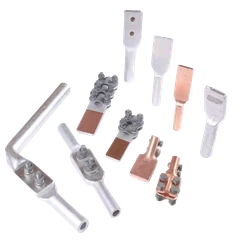
DTL bi metal lugs (copper-aluminum connectors) are crimp-type transition terminals featuring an integrated copper-aluminum structure.
- Applicable Conductors: Compatible with aluminum stranded wire (LJ), steel-core aluminum stranded wire (LGJ), and copper stranded wire (TJ), with conductor cross-sections ranging from 10 to 630 mm², meeting the connection requirements for both copper and aluminum conductors
- Applications: Overhead transmission and distribution lines up to 10 kV, substations, distribution panels, and motor equipment, used for splicing and connecting copper and aluminum conductors and equipment terminals
- Operating Temperature: Continuous operation from -40°C to +85°C; short-term resistance up to 120°C; suitable for complex high- and low-temperature conditions in both outdoor and indoor environments

Typical Application Scenarios
Applications
◆Photovoltaic power generation system cable connections
◆Substation and distribution box equipment wiring
◆Industrial automation control cabinets
◆Transition connections between aluminum-core cables and copper terminal equipment

Use Cases


Quality and Inspection
◆ Material inspection: The copper end shall be T2 copper (purity ≥99.9%), and the aluminum end shall be L3 or 1060 industrial pure aluminum.
◆ Weld inspection: Metallographic examination of the weld interface shall show no cracks or porosity, and the bonding rate must reach 100%.
◆ Performance testing: Must pass DC resistance test, thermal cycling test (1000 cycles), short-circuit current endurance test, and salt spray test (96 hours).
Certificates
Please feel free to contact us with any inquiries.


FAQ
Q: In which scenarios are DTL bi metal lugs primarily used for wire connections?
A: They are primarily used for transition connections between copper and aluminum wires, as well as between copper and aluminum cables. They are suitable for wiring in 10kV–500kV transmission and distribution lines, substations, distribution panels, motors, transformers, and other equipment. They address the issue of electrochemical corrosion caused by direct contact between copper and aluminum materials, providing both electrical conductivity and mechanical fastening.
Q: What are the common models of DTL bi metal lugs? What wire specifications do they support?
A: Common models are categorized by wire cross-sectional area and include DTL-16, DTL-25, DTL-35, DTL-50, DTL-70, DTL-95, DTL-120, DTL-185, DTL-240, DTL-300, DTL-400, etc.; they are compatible with 16mm²–400mm² copper stranded wire (TJ), copper-core cable, aluminum stranded wire (LJ), and steel-core aluminum stranded wire (LGJ), enabling transition connections between copper and aluminum of the same or different cross-sections.
Q: What is the core function of DTL bi metal lugs?
A: As a specialized transition fitting for copper-aluminum conductors, one end is designed for copper conductors/cables, while the other end is designed for aluminum conductors/cables. Through a copper-aluminum transition structure (combining diffusion welding and crimping), it prevents electrochemical corrosion caused by direct contact between copper and aluminum, while ensuring electrical conductivity (low contact resistance) and mechanical connection strength to transmit current and handle circuit loads.
Hot Tags: bi metal lug, China bi metal lug manufacturers, suppliers, factory


